

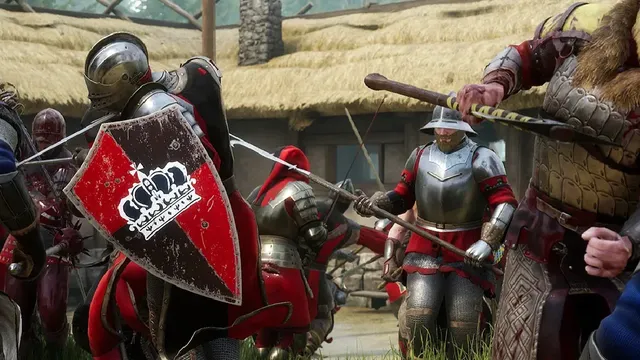
Last night I cut a man’s arm off with a longsword, picked up the severed limb, and threw it at his teammate’s face. The teammate staggered. I killed him with an overhead axe swing. Then a bard ran past me playing a lute while a 64-player battle raged around us and someone in voice chat screamed “FOR THE BLUE AND GOLD” with genuine conviction.
This is Chivalry 2. And I need you to understand that underneath all of this — the severed limbs, the lute performances, the chicken projectiles — is one of the deepest melee PVP combat systems ever designed. The comedy isn’t hiding the depth. It’s coexisting with it. And that coexistence is exactly what makes Chivalry 2 special.

The Combat System Nobody Talks About
Here’s what most coverage of Chivalry 2 gets wrong: they describe the chaos, the humor, the medieval sandbox. They rarely explain why the combat feels good. So let me explain it, because the system Torn Banner built deserves the same analysis we give fighting game mechanics.
Chivalry 2’s melee combat is built on swing manipulation. When you start an attack, the damage isn’t applied at the moment you click — it’s applied when the weapon’s hitbox physically contacts the target during the swing arc. This means you can change when and where your attack connects by moving your camera during the swing.
Drags are swings where you pull your camera away from the target, slowing the point of contact. Your opponent sees the attack start, times their block, and the hit lands late — after their block window has closed. Accels are the opposite: you snap your camera toward the target, making the hit connect earlier than expected. The defender blocks on the natural timing and gets hit before their guard is up.
This is the foundation, and it already creates a rich skill gap. But it’s the defensive layer that makes the system sing. Ripostes are attacks launched immediately after a successful block. They have hyper armor — they can’t be interrupted by enemy swings. This means blocking isn’t just survival; it’s the setup for your own offense. Counters go further: if you match the enemy’s attack type (slash against slash, stab against stab) with correct timing, you get an even faster riposte with extended hyper armor.
Then there are feints — canceling an attack startup into a different attack or into a block. Feints punish players who react too early. They create a layer of mind games on top of the physical swing manipulation.
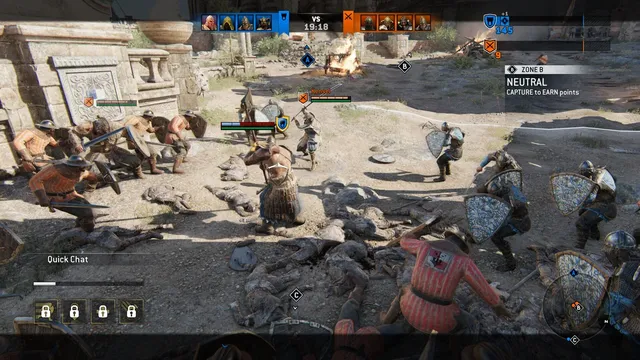
I wrote about For Honor’s directional combat and how its Art of War system builds depth through reading your opponent. Chivalry 2 achieves something similar through completely different means. Where For Honor is about direction and indicator reads, Chivalry 2 is about timing manipulation and spatial awareness. Both games make melee PVP feel like a conversation between two players. They just speak different languages.
Why the Chaos Works
Chivalry 2’s 64-player Team Objective mode sounds like the opposite of competitive depth. How can a melee combat system be skill-testing when there are 63 other people on the battlefield?
The answer is that the chaos creates context for the combat system, not a replacement for it. In a 64-player battle, every engagement is unique. You’re fighting one person when their teammate flanks you. You riposte the first attacker and drag the swing to catch the flanker. A third enemy charges in, and you counter their overhead and use the hyper armor to survive long enough for your own teammates to arrive.
These moments aren’t scripted. They emerge from the intersection of a deep combat system and a large-scale battlefield. The player who understands drags, accels, ripostes, and counters survives these encounters. The player who doesn’t gets overwhelmed. The skill gap isn’t diminished by the chaos — it’s amplified by it, because the skilled player is making dozens of micro-decisions per engagement while the unskilled player is just swinging and hoping.
This is something most PVP games get wrong: they assume that competitive depth requires controlled conditions. Sterile arenas. Matched team sizes. Elimination of randomness. And those things matter for formal competition. But the feeling of being skilled — the flow state where your game knowledge and mechanical ability let you navigate a situation that would overwhelm a lesser player — that feeling is strongest when the situation is uncontrolled. When you clutch a 1v3 in a castle hallway because you used the doorframe to funnel attackers and counter-dragged every swing, you feel like a god. No ranked ladder can give you that.

The 1v1 Depth Nobody Sees
Strip away the 64 players. Remove the siege objectives. Put two experienced players in a duel server. This is where Chivalry 2 reveals itself as a genuinely deep competitive experience.
High-level Chivalry 2 duels look nothing like the chaotic battlefield gameplay. They look like fighting games. Two players at mid-range, probing with feinted attacks, looking for patterns. One throws a drag — the other reads it, delays their block, and counters into a riposte. The first player morphs their next attack (starting as a slash, switching to an overhead mid-swing), trying to break the counter timing. The second player feints a response, then punishes with a jab into a combo.
The depth of reads in these encounters is comparable to what you see in Guilty Gear Strive or high-level For Honor. You’re reading your opponent’s habits, adapting your timing, managing your stamina (the game’s equivalent of a resource meter), and making split-second decisions about whether to commit, feint, or counter. The cooldown trading concept applies directly here — stamina is a depleting resource, and every attack, feint, and block costs some. Forcing your opponent to spend stamina while conserving your own is a winning strategy that separates intermediate players from advanced ones.
The problem is that almost nobody sees this. The duel community is dedicated but small. Competitive tournaments exist but get minimal attention. The game’s public image is “funny medieval chaos game,” and Torn Banner has leaned into that marketing because it moves copies. The depth is there for anyone who looks. Most people never look.
The Accessibility Win
Here’s what Torn Banner got right that Mordhau — Chivalry’s spiritual competitor — got catastrophically wrong: accessibility.
Mordhau has arguably deeper swing manipulation. Its combat system rewards dedicated practice with an even wider range of techniques. But its community is one of the most hostile in gaming, its tutorial barely teaches the basics, and a new player’s first 50 hours are an unrelenting parade of getting destroyed by veterans who have perfected animations that are nearly impossible to read without hundreds of hours of experience.
Chivalry 2 took the same core concept — first-person melee combat with swing manipulation — and made it approachable. The tutorial explains drags and feints. The 64-player modes let new players contribute to their team even while they’re still learning. The humor and spectacle keep players engaged through the frustration of early losses. And critically, the basic combat — block, swing, special attack — is immediately functional. You can have fun on your first day.
This is the same lesson that Guilty Gear Strive teaches: accessibility doesn’t mean dumbing the game down. It means making the floor low enough that new players can stand on it while keeping the ceiling high enough that mastery takes thousands of hours. Chivalry 2 nails this balance. A new player can block and swing and have a good time in Team Objective. A veteran can drag, accel, feint, morph, counter, and riposte their way through 1v3 encounters. Both players are playing the same game. They’re just engaging with different layers of it.
What Holds It Back
Chivalry 2 isn’t perfect, and its problems are real enough to explain why it hasn’t achieved the competitive recognition it deserves.
Server performance is inconsistent. In a game where the difference between a successful drag and a missed block is measured in fractions of a second, server tick rate and latency matter enormously. Some matches feel crisp and responsive. Others feel sluggish, with hits landing that shouldn’t and blocks failing that should work. This inconsistency erodes trust in the combat system, and trust is essential for competitive play.
Content updates slowed. Torn Banner shifted resources toward other projects, and the cadence of new maps, weapons, and features decreased. The core combat is strong enough to sustain long-term play, but competitive communities need fresh content and active balance attention to stay engaged.
No serious competitive infrastructure. There’s no ranked 1v1 mode. No official tournament support. No replay system for analyzing matches. The duel community has built its own infrastructure around community servers and Discord tournaments, but the lack of official support sends a message: Torn Banner doesn’t see Chivalry 2 as a competitive game. And if the developer doesn’t, why would anyone else?
This is the frustrating part. The combat system is there. The depth is there. The player base, while not massive, is dedicated. What’s missing is the institutional support that turns a good competitive game into a recognized one.

The Real Lesson
Chivalry 2’s existence proves something important about PVP game design: a game can be funny and deep at the same time. Seriousness is not a prerequisite for competitive quality. The chicken-throwing doesn’t diminish the drag-accel mind games. The lute-playing doesn’t make the riposte system less skill-testing. The comedy and the depth operate on different frequencies, and both are genuine.
This matters because PVP game design has been trending toward sterility. Clean interfaces, controlled environments, ranked ladders, esports readiness. All important things. But Chivalry 2 reminds us that competitive PVP was born in chaos — in Quake servers, in StarCraft custom maps, in fighting game arcades where someone was always talking trash. The joy of competition isn’t just the leaderboard. It’s the story. It’s cutting someone’s arm off and throwing it at their friend. It’s clutching a 1v4 on the castle ramparts while your team charges in behind you. It’s emergent, unpredictable, and deeply human.
The best PVP games understand that depth and fun aren’t competing priorities. They’re the same thing, experienced at different levels. Chivalry 2 understands this better than almost any game in the genre. It just has the misfortune of being so entertaining on the surface that most people never bother to look underneath.
They should.
Discussion