
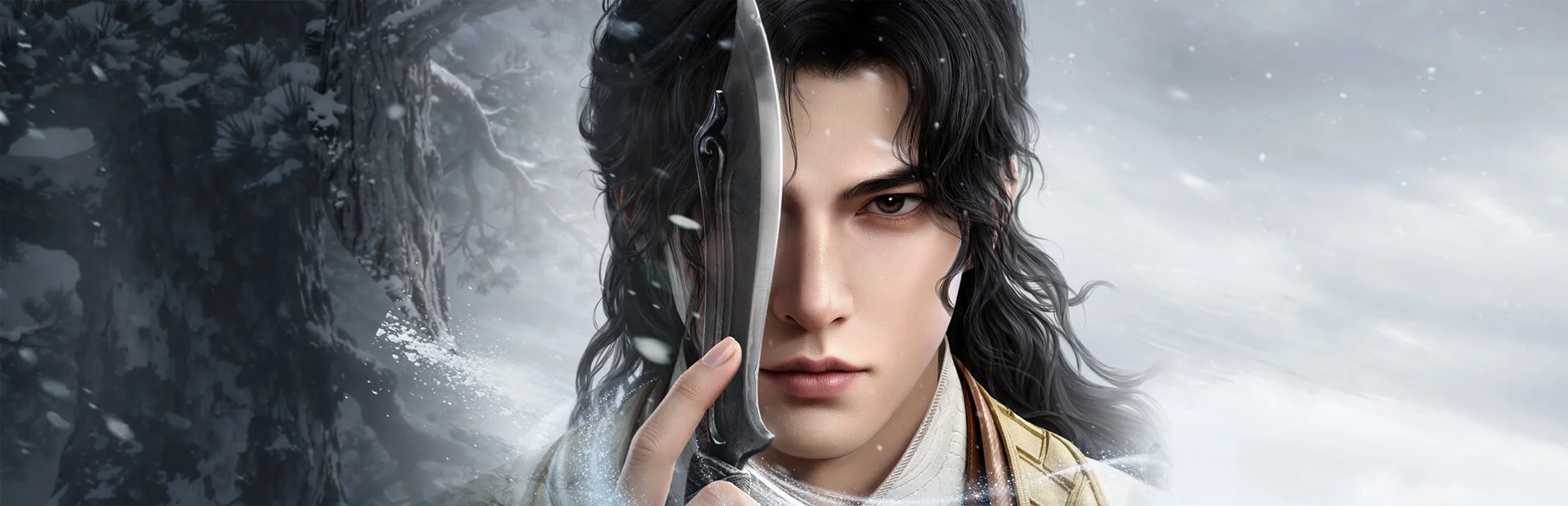
The first time you grapple-hook off a temple rooftop, land on someone mid-air, and parry their longsword swing into a full combo that sends them ragdolling into a courtyard below, you understand what Naraka: Bladepoint is doing. This is not a battle royale with melee tacked on. This is a martial arts action game that happens to take place in a battle royale.
Every major BR before Naraka assumed the same thing: battle royale means guns. PUBG, Fortnite, Apex Legends, Warzone — they all built their core loops around ranged combat with occasional melee as a desperate last resort. 24 Entertainment looked at that assumption and asked what would happen if swords were the primary weapon and guns were the sidearm. The answer turned out to be one of the most mechanically interesting PVP games of the last five years, and most of the Western competitive community slept right through it.
The Combat Triangle
Naraka’s entire combat system runs on a rock-paper-scissors triangle: normal attacks beat focus attacks, focus attacks beat parries, parries beat normal attacks. That’s it. Three options. And it creates more depth than most games achieve with twenty abilities.
Here’s why. Normal attacks are your standard melee combo strings — fast, interruptible, and the bread-and-butter of any engagement. Focus attacks are charged strikes with hyper armor, meaning they can’t be staggered out of by normal hits. They’re slow and telegraphed, but they deal massive damage and blow through standard offense. Parries are a timed defensive window that punishes normal attacks with a stagger, opening the attacker up for a free combo. But parries lose to focus attacks — if you parry against a focus strike, you eat the full charge.
This creates a constant reading game. You see your opponent start a combo string — do you parry it, risking that they’ll cancel into a focus attack? Do you try to out-trade with your own normals, gambling that your weapon has better range? Do you charge a focus attack to armor through their pressure, betting that they won’t just dodge away and punish the recovery?
The system rewards adaptation the same way For Honor’s directional combat does — you’re not just executing your game plan, you’re reading your opponent’s habits and adjusting in real time. The difference is that Naraka layers this over a movement system so fast and vertical that the reads happen at twice the speed.
If you’ve played arena brawlers, the triangle will feel familiar. Battlerite’s counter mechanic worked on the same principle — attacking into a counter punished you, but baiting the counter created a window. Naraka took that concept and made it the entire combat system instead of just one ability. Every swing, every parry timing, every charged focus strike is a cooldown trade disguised as a fighting game interaction.
Movement as Identity
Strip the combat away and Naraka would still be interesting, because the movement system is genuinely unlike anything else in the genre.
Every character has a grapple hook with limited range and a short cooldown. You can grapple to any surface — rooftops, cliffs, tree branches, other players. Combined with wall-running, charged jumps, and air dashes, the result is a traversal system that feels closer to Sekiro than to any battle royale. You are constantly moving in three dimensions. Fights don’t happen in fields — they happen on rooftops, mid-air, on cliff faces, and across vertical space that most BRs treat as decoration.
This changes the entire flow of engagement. In Apex Legends, third-partying works because you can hear gunshots from 200 meters away and push toward them. In Naraka, you hear the clash of weapons and you grapple-hook directly into the fight from above. Disengaging isn’t about running across open ground — it’s about grappling to high ground, breaking line of sight vertically, and resetting from a position your opponent can’t easily follow.
The movement also raises the skill floor for the combat triangle. Parrying a grounded opponent who’s swinging a longsword is one thing. Parrying someone who just grappled onto your ledge from below while you’re mid-wall-run is an entirely different test. The best Naraka players combine the combat reads with movement so fluidly that fights look choreographed — which is exactly what a martial arts action game should feel like.

Hero Design: Abilities That Accent, Not Dominate
Naraka has a roster of heroes with unique abilities, and the design philosophy is exactly right for a game built around a core combat system: the abilities matter, but they never override the fundamentals.
Take Matari, the stealth assassin. Her ability lets her go invisible for a short duration or create a teleport tether. These are powerful tools for repositioning and initiating, but once she’s in melee range, she still has to win the same rock-paper-scissors game as everyone else. Invisibility doesn’t help you if you parry into a focus attack.
Compare this to how Battlerite handled hero design. Both games give every character the same core combat system and layer unique abilities on top. Battlerite’s counters, escapes, and ultimates gave each champion a distinct identity while the M1/M2 skillshot combat stayed universal. Naraka does the same — the triangle is universal, the hero abilities are personal. Yoto Hime’s spectral slash and Tianhai’s titan transformation are dramatic, flashy tools that create moments. But the player who wins is still the one who reads the parry timing better.
This is a harder design approach than it sounds. Most hero-based games let abilities do the heavy lifting — pick the right character, press the right buttons, win. Naraka demands that you master the combat system first and use abilities as multipliers. The heroes feel different to play without feeling like different games.
Why the West Slept on It
Naraka launched in August 2021 to massive success in China and Southeast Asia. It debuted with over 100,000 concurrent players on Steam and maintained a healthy population. In the West, it was largely ignored.
Part of this was timing — Naraka launched into a BR market already saturated by Apex, Warzone, and Fortnite. Western audiences looked at it, saw “another battle royale” in the store description, and moved on. The wuxia aesthetic, while gorgeous, didn’t have the instant recognition factor of a Marvel IP or a military setting. Most gaming outlets covered it briefly and moved on to the next thing.
Part of it was the free-to-play transition. Naraka launched as a paid game ($20), which was a barrier for a genre that had been free since Fortnite. When it moved to free-to-play on PC and launched on Xbox with Game Pass in 2023, it gained traction in the West — but by then, first impressions had already calcified. The narrative was set: Naraka was “that Asian BR” and most competitive Western players never gave it a serious look.
This is a pattern that repeats across PVP gaming. Games that don’t fit neatly into Western genre expectations get dismissed on sight. For Honor suffered from a similar problem — it built something genuinely new, but the marketing couldn’t communicate why it was different in a way that overcame initial skepticism.
What Holds It Back
Naraka is not a perfect game. Its biggest problem is the one that plagues every battle royale: randomness in the loot loop undermines the skill expression.
You can be the best melee player in the lobby, but if you drop into a cold zone and find only white-tier weapons while your opponent landed on a legendary longsword, the gear gap matters. Naraka is better about this than most BRs — the combat triangle works at any gear level, and a skilled player with a blue weapon can absolutely outplay a mediocre one with gold. But the gap still exists, and it creates frustrating moments that a pure arena mode wouldn’t.
The ranked mode alleviates some of this by pushing everyone toward contested drops where gear evens out faster, and the game’s Bloodbath mode (a smaller, faster format) reduces the loot variance significantly. But the core BR mode, the one most players experience first, still has the loot problem. It’s the genre’s original sin, and no game has fully solved it.
Hero balance is also an ongoing conversation. With each season patch, the meta shifts, and some heroes feel clearly stronger than others. Tianhai’s titan form has historically been a balance headache — a giant-sized melee form that dominates team fights in ways that are hard to counter without specific hero picks. 24 Entertainment has been responsive to balance, but the hero pool is small enough that a single overtuned pick warps the meta.
Queue times in Western regions can also be rough during off-peak hours. The game is healthy globally, but if you’re playing NA servers at 3 AM, you’ll notice.
The Lesson Nobody Learned
Naraka: Bladepoint proved something that the PVP industry should have internalized by now: genre conventions are arbitrary. Battle royale doesn’t have to mean guns. Melee PVP doesn’t have to mean 1v1 arenas or small team formats. If the core combat system is good enough — if the moment-to-moment skill expression is high enough — the format will work.
The combat triangle gives every engagement a read-based depth that most BRs lack entirely. The movement system makes the whole map feel like a playground instead of a running simulator. The hero abilities add flavor without diluting the fundamentals. Naraka took a genre defined by looting and shooting and proved that the “shooting” part was never the point — the point is PVP, and PVP works in any system where skilled players can consistently outperform less skilled ones.
This is the same lesson that Deadlock is teaching the MOBA space — that genre boundaries are suggestions, not rules. The developers who make the next great PVP game probably won’t do it by refining an existing formula. They’ll do it by combining ideas that nobody thought belonged together and building a combat system good enough to make it all feel inevitable.
Naraka did that. It deserves more credit for it. And if you haven’t tried it since its free-to-play transition, you owe yourself a few evenings of grapple-hooking off rooftops and sword-fighting in mid-air. It’s the best battle royale experience that most competitive PVP players have never touched.
Discussion